
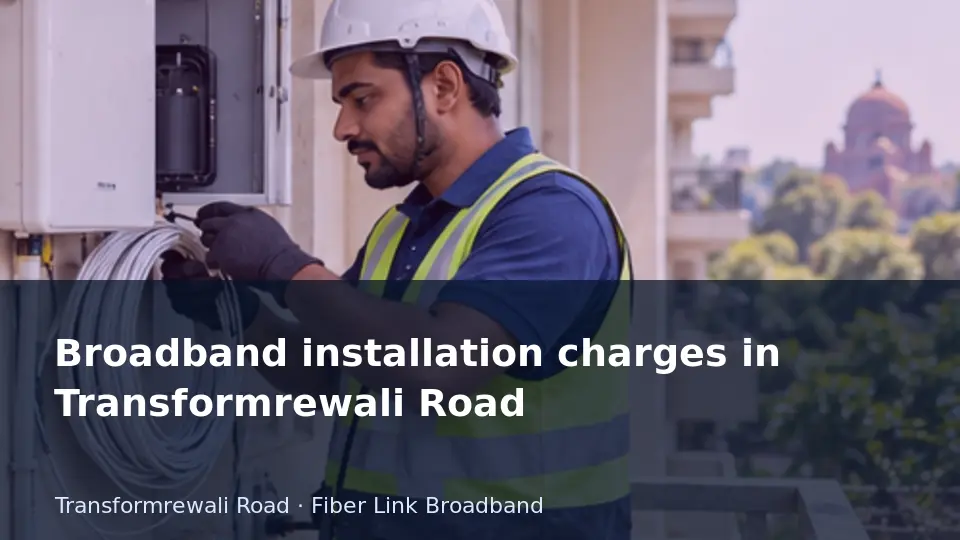
A standard installation offer may cover a defined scope rather than any cable route. A longer or more complex path should be agreed before work begins.
This guide is for readers planning or reviewing a connection in Transformrewali Road. It separates the decision you can make now from details that need an address-specific reply. The examples describe checks you can perform or discuss with the installer; they are not reports of a customer installation, measured local speeds or a promise that every nearby building is serviceable.
Build a quote you can compare
Begin with the period you actually intend to use the service. A monthly equivalent, a fixed validity period and a calendar-month bill are not interchangeable. For each offer, list the service charge, applicable taxes, setup work, equipment payments and the amount due at renewal. Show refundable security separately from non-refundable expenditure so the first payment does not get confused with the long-term cost.
Next, record what happens when circumstances change. Ask about upgrades, relocation, cancellation, equipment returns and unused validity. These conditions are provider-specific and should be obtained with the quote instead of inferred from another customer's experience. If a promotion has an expiry or eligibility rule, keep it beside the advertised benefit. A useful decision compares equivalent scope over equivalent time. It also asks whether the package meets the actual workload and whether an indoor-network improvement would be more relevant than a recurring speed upgrade. Keep the written quotation and receipt together for later billing questions.
Separate the property agreement from the service agreement
In a rental, permission to occupy the premises does not automatically settle permission for every installation method. Discuss drilling, visible cable, shared routes and equipment placement with the authorised property contact. The provider should then assess whether the permitted route is workable. Keep the approved scope available for the technician so an arrival does not turn into an unresolved permission discussion.
The subscription has its own questions. Identify the account holder, payment responsibility, intended stay and equipment ownership. Ask about relocation, cancellation and the return of loaned or secured equipment before taking a long commitment. A router already in the property does not prove that the account is active or transferable. At move-out, use the provider's documented process and retain an acknowledgement rather than assuming that unplugging the equipment closes the service. For shared residences, agree how faults and renewals are handled while keeping administrator credentials private. Clear responsibilities make both installation and departure easier to manage.
1. Confirm building-specific installation costs before payment
Access arrangements can change the work needed to reach an apartment. A quote based only on a locality name may miss restrictions or extra routing.
Next step: Share the floor and permitted cable path, then ask the provider to confirm the complete payable amount for that address.
2. Ask what happens if installation proves infeasible
An address check can reveal a cable route or permission problem after an initial enquiry. Payment and refund expectations should be established before money changes hands.
Next step: Ask when payment is required and how an unsuccessful installation is handled, retaining a written reference for the enquiry.
3. Separate installation labour from equipment security
Free installation does not necessarily mean no first-day payment. Router security, additional cable work or other agreed items may have separate terms.
Next step: Request an itemised quote showing which payments are refundable and which are charges for completed work.
4. Compare WiFi plans using the busiest household hour
Plan comparison starts with the work the connection must support. A lower tier can be good value when it meets the actual workload and room coverage is sound.
Next step: Write down simultaneous activities and compare the full recurring bill for the tiers that can support them.
5. Check postpaid closure terms before taking a connection
Stopping use is not necessarily the same as formally closing an account. The cancellation process and final-bill timing should be clear at signup.
Next step: Ask how to submit closure, return equipment and obtain an acknowledgement; retain the response for the end of the tenancy.
6. Check whether the router is owned or returnable
An included router may be sold, loaned or supplied against refundable security. Those arrangements have different consequences when service ends.
Next step: Obtain the ownership terms, return condition and refund process and keep the equipment handover record.
7. Agree the installation scope before reserving a slot
Booking a visit and agreeing the work are separate steps. Router position, cable route and any additional equipment should be discussed while changes remain easy.
Next step: Send a simple description of the required rooms and ask which work is included in the proposed visit.
8. Inspect the completed cable route before handover
The finished route should be secure and appropriate for doors, walkways and shared areas. Discuss concerns while the installer can explain the work.
Next step: Ask the technician to review exposed sections and avoid handling or sharply bending the fiber yourself.
9. Include Ethernet needs in the home installation request
A desktop, console or television may benefit from a wired connection. It is easier to discuss the cable route before installation than after the router is fixed.
Next step: List the stationary devices and ask whether their cable runs are included or separately quoted.
10. Check the support path offered by a local company
Being local does not automatically define response times or escalation. Ask how a fault is logged and how updates are communicated.
Next step: Record the official support route and any written commitment instead of relying on an informal promise during signup.
11. Choose the fiber entry point before the technician arrives
The easiest external entry is not always the best indoor route. A planned entry can reduce exposed cable and avoid an inconvenient router position.
Next step: Identify a permitted route with the property owner and keep bends and doorways for the technician to assess safely.
12. Plan apartment installation through shared spaces
An apartment cable route may pass through property managed by someone other than the resident. The route and permission should be agreed before work begins.
Next step: Confirm the permitted shaft or corridor path and who can authorise access, keeping the building's instructions with the booking.
13. Ask about relocation before committing at a temporary address
A new connection can be useful now even if a move is likely later. Relocation feasibility and charges remain separate from current-address installation.
Next step: Describe the expected move and request the applicable transfer or closure terms without assuming the next building is covered.
14. Is 200 Mbps useful when WiFi is the bottleneck
A faster subscription cannot remove a weak wireless signal in a distant room. Establish whether the current line or the indoor connection is limiting the task.
Next step: Compare Ethernet and room WiFi on a capable device before changing the package.
15. Judge local reliability using a support record
A reliable-provider claim should be tested against clear service terms and observed experience. A locality keyword or a maximum speed result is weak evidence by itself.
Next step: Ask about fault reporting and keep dated records of your own connection rather than treating a general slogan as proof.
16. Check equipment compatibility before requesting gigabit
A gigabit request requires more than a plan label. The terminal, router ports, cable and test device can each impose a lower limit.
Next step: Ask for current gigabit availability at the address and verify port capabilities; the site's standard plan table does not establish a gigabit offer.
17. Build a family broadband decision together
Family members may have different priorities, from classes to remote work and evening viewing. Gather those needs before deciding that one person's speed test represents everyone.
Next step: List the simultaneous activities and agree which rooms require dependable service at the same time.
Use the guide for your address
For Transformrewali Road, send Fiber Link Broadband the complete building address, floor and map pin when requesting feasibility or a current quotation. Mention the particular requirement covered by this article so the reply can address your use case. Ask for the service scope, equipment responsibilities and complete payable amount in writing. Retain the response alongside your installation or support record, and revisit any unanswered point before committing to a longer payment period.
Contact 9971524677 or 9990881098. Review the published plan information and request an address check. Current availability and terms need confirmation.
All Fiber Link broadband plans
Compare the monthly plans listed on our broadband plans page.
| Plan | Speed | Monthly price | Included benefits | Availability |
|---|---|---|---|---|
| Fiber Start | 100 Mbps | ₹499/month | Unlimited data, free installation, 24×7 customer support | Enquire |
| Fiber Plus | 200 Mbps | ₹699/month | Unlimited data, free installation, 24×7 priority support | Enquire |
| Fiber Pro | 300 Mbps | ₹799/month | Unlimited data, free installation, 24×7 priority support | Enquire |
| Fiber Ultra | 500 Mbps | ₹1,699/month | Unlimited data, free installation, 24×7 priority support | Enquire |
Router and billing terms: 5G dual-band Wi-Fi router refundable security applies. Confirm the deposit, applicable taxes, billing period, complete first payment and installation feasibility for your address before booking. Terms apply.
Business leased line: Custom bandwidth, equal upload and download speeds, SLA-backed uptime, static IP options and priority local support. Call 9971524677 for a custom quote.