
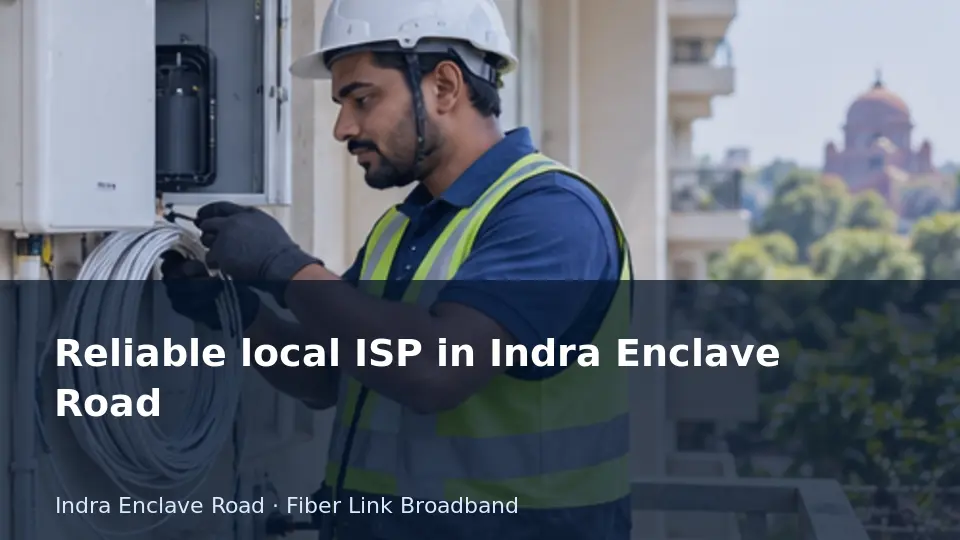
A reliable-provider claim should be tested against clear service terms and observed experience. A locality keyword or a maximum speed result is weak evidence by itself.
This guide is for readers planning or reviewing a connection in Indra Enclave Road. It separates the decision you can make now from details that need an address-specific reply. The examples describe checks you can perform or discuss with the installer; they are not reports of a customer installation, measured local speeds or a promise that every nearby building is serviceable.
Compare evidence rather than marketing labels
Provider selection is easier when every candidate receives the same brief. Supply the exact address, intended billing period, essential rooms and simultaneous activities. Ask for a clear feasibility response and a quotation that includes equipment and installation scope. A generic locality page or a nearby customer's connection can inform the enquiry but cannot settle whether your particular premises is ready for service.
Evaluate the support process alongside the commercial offer. Find out how faults are logged, who provides updates and which equipment the provider manages. A local contact can be useful, but the process should not depend entirely on reaching one person informally. Avoid unsupported rankings such as fastest or best when the available evidence is only one test or an advertisement. Your decision can instead be specific and defensible: the address was confirmed, the terms were clear, the required workload was understood and the support arrangement was acceptable. Save the documents that support those conclusions for the eventual installation and renewal review.
Build a quote you can compare
Begin with the period you actually intend to use the service. A monthly equivalent, a fixed validity period and a calendar-month bill are not interchangeable. For each offer, list the service charge, applicable taxes, setup work, equipment payments and the amount due at renewal. Show refundable security separately from non-refundable expenditure so the first payment does not get confused with the long-term cost.
Next, record what happens when circumstances change. Ask about upgrades, relocation, cancellation, equipment returns and unused validity. These conditions are provider-specific and should be obtained with the quote instead of inferred from another customer's experience. If a promotion has an expiry or eligibility rule, keep it beside the advertised benefit. A useful decision compares equivalent scope over equivalent time. It also asks whether the package meets the actual workload and whether an indoor-network improvement would be more relevant than a recurring speed upgrade. Keep the written quotation and receipt together for later billing questions.
Ask who owns an unresolved support request
Local contact can be helpful, but a fault needs a record that survives a change of staff. An official ticket makes follow-up clearer.
Check the support path offered by a local company
Being local does not automatically define response times or escalation. Ask how a fault is logged and how updates are communicated.
Ask a provider how it separates line faults from WiFi faults
The outside connection and the indoor wireless network need different checks. A useful support process explains how it distinguishes them.
Define reliability for your own household
A household that depends on work calls may value predictable recovery more than occasional peak throughput. State what a disruption would affect before comparing options.
Choose broadband using an address-and-workload brief
A precise address establishes whether installation is possible; a workload brief establishes what the connection must do. Neither replaces the other.
Choose apartment broadband with building access in mind
A provider may operate nearby yet need permission to use the apartment's shared route. Equipment placement and access can matter as much as the subscription.
Report an intermittent fault with timestamps
An intermittent connection can appear normal when support tests it later. A time-based record gives the team a better chance of matching the symptom to network events.
Keep a first-evening baseline after activation
The first normal evening is a useful time to record how the connection behaves with real household use. That record can support later fault comparisons.
Compare WiFi plans using the busiest household hour
Plan comparison starts with the work the connection must support. A lower tier can be good value when it meets the actual workload and room coverage is sound.
Keep local smart-home controls usable during an outage
Some devices communicate locally while others depend on an internet service. A broadband interruption can therefore affect two apparently similar devices differently.
Compare support and equipment alongside monthly price
A plan that meets the speed requirement may still involve different support or router arrangements. Price is useful only when the included service is understood.
Prepare for activation after the physical cable is fitted
A fitted cable is only one stage of the installation. The terminal, account and local network must also be ready before normal internet use is demonstrated.
Read terminal lights before reporting a fiber fault
The optical terminal's indicators can provide useful clues, but labels vary by model. A clear photo and the equipment model help support interpret them.
Onboard smart devices without weakening the whole network
Some small home devices support only a particular WiFi band or security mode. A failed setup is not evidence that the broadband line is faulty.
Choose between 2.4 GHz and 5 GHz using a room test
A device may work faster near the router on 5 GHz but stay connected farther away on 2.4 GHz. The result depends on the device, obstacles and interference.
Keep the booking receipt and account details together
Payment evidence and service details are easiest to manage when stored as one installation record. They help resolve questions about the agreed package later.
Escalate a recurring fault using its history
A recurring issue deserves a summary of previous incidents rather than a fresh disconnected story each time. A concise history makes the pattern visible.
Use the guide for your address
For Indra Enclave Road, send Fiber Link Broadband the complete building address, floor and map pin when requesting feasibility or a current quotation. Mention the particular requirement covered by this article so the reply can address your use case. Ask for the service scope, equipment responsibilities and complete payable amount in writing. Retain the response alongside your installation or support record, and revisit any unanswered point before committing to a longer payment period.
Contact 9971524677 or 9990881098. Review the published plan information and request an address check. Current availability and terms need confirmation.
All Fiber Link broadband plans
Compare the monthly plans listed on our broadband plans page.
| Plan | Speed | Monthly price | Included benefits | Availability |
|---|---|---|---|---|
| Fiber Start | 100 Mbps | ₹499/month | Unlimited data, free installation, 24×7 customer support | Enquire |
| Fiber Plus | 200 Mbps | ₹699/month | Unlimited data, free installation, 24×7 priority support | Enquire |
| Fiber Pro | 300 Mbps | ₹799/month | Unlimited data, free installation, 24×7 priority support | Enquire |
| Fiber Ultra | 500 Mbps | ₹1,699/month | Unlimited data, free installation, 24×7 priority support | Enquire |
Router and billing terms: 5G dual-band Wi-Fi router refundable security applies. Confirm the deposit, applicable taxes, billing period, complete first payment and installation feasibility for your address before booking. Terms apply.
Business leased line: Custom bandwidth, equal upload and download speeds, SLA-backed uptime, static IP options and priority local support. Call 9971524677 for a custom quote.