
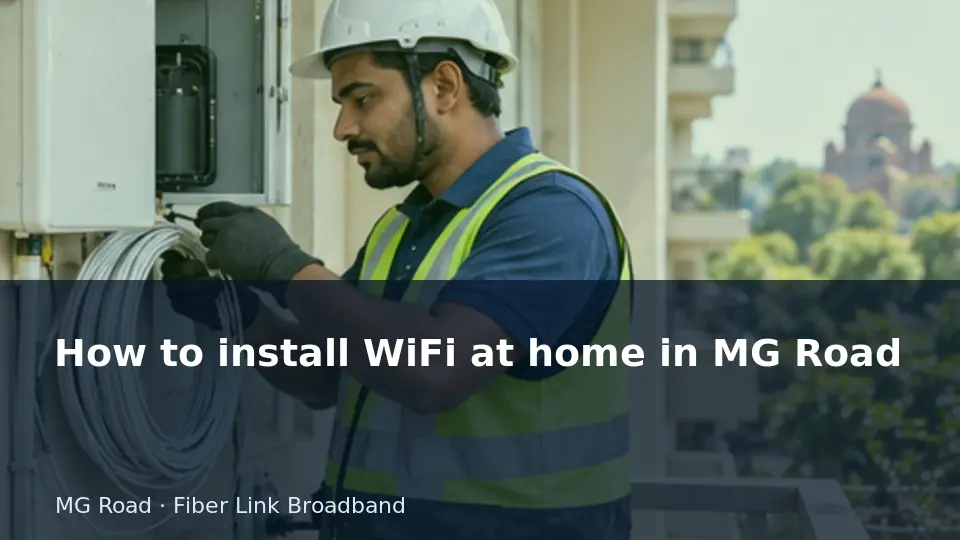
A router installed beside the closest socket may leave the work desk or television poorly served. Mark the important rooms before deciding its position.
This guide is for readers planning or reviewing a connection in MG Road. It separates the decision you can make now from details that need an address-specific reply. The examples describe checks you can perform or discuss with the installer; they are not reports of a customer installation, measured local speeds or a promise that every nearby building is serviceable.
Make the installation brief address-specific
A locality name is the beginning of an enquiry, not a completed feasibility check. The provider still needs the building, unit, floor and practical cable route. A map pin helps locate the property, while a written entrance description explains how the technician should reach it. Mention restrictions involving shared spaces, terraces, shafts or building work hours before reserving the appointment.
Discuss the indoor outcome at the same time. Identify the important rooms, stationary devices and any planned Ethernet connections. Agree where the terminal and router can receive safe power, and who can approve a change to the route or quotation. An installation is ready for handover when the account is active and the agreed devices and work locations have been checked, not simply when a cable has been fitted. Retain the service identifier, equipment details and support contact. Never look into an optical connector or attempt to splice a damaged fiber; leave that work to the trained technician.
Create evidence that support can use
The most useful fault report says what failed, when it began and how broadly it affects the connection. Distinguish one device, one room and all devices. Note whether the optical terminal is powered and describe its labelled indicators without guessing their meaning. If a safe wired comparison is possible, include that result as well as the wireless symptom. Use the model's instructions or the provider's guidance for any restart.
Keep an account reference and a ticket number, but never include passwords, one-time codes or unrelated private information. A normal restart should not be confused with a factory reset, which can erase configuration and complicate diagnosis. For an intermittent issue, timestamps and recovery times help more than repeated vague messages. Update the existing ticket when new evidence appears, and ask for the next action or update time. If a physical fiber route looks damaged, leave connectors and repairs alone and arrange professional attention. An organised report cannot guarantee immediate repair, but it removes avoidable uncertainty from the investigation.
1. Plan around the building's allowed work hours
A provider's appointment window may not match the times when a building permits cable work. Resolve that mismatch before reserving the visit.
Next step: Check the access window with the responsible person and have the provider confirm a compatible slot.
2. Request a connection with a clear room-coverage brief
The phrase new WiFi connection can mean very different things in a one-room unit and a larger home. State the expected use locations at the start.
Next step: List essential rooms and fixed devices, then ask which coverage outcomes the proposed equipment can reasonably support.
3. Use a PIN code as a starting point for an address check
A PIN code covers more than a single building. Requests for 110030, 110068 or 110074 need the exact location before service can be confirmed.
Next step: Provide the full address and map pin and request current feasibility; do not infer coverage for every property sharing the code.
4. Keep the old connection until the new one is tested
A change of provider can leave a gap if the previous service is cancelled before the replacement works. Plan the transition around an actual activation test.
Next step: Where practical, overlap the services briefly and verify your essential devices before closing the old account.
5. Include Ethernet needs in the home installation request
A desktop, console or television may benefit from a wired connection. It is easier to discuss the cable route before installation than after the router is fixed.
Next step: List the stationary devices and ask whether their cable runs are included or separately quoted.
6. Choose the fiber entry point before the technician arrives
The easiest external entry is not always the best indoor route. A planned entry can reduce exposed cable and avoid an inconvenient router position.
Next step: Identify a permitted route with the property owner and keep bends and doorways for the technician to assess safely.
7. Agree shared-home rules for large transfers
A shared home can experience avoidable congestion when every resident starts backups at the same time. Clear scheduling can be more effective than repeatedly restarting the router.
Next step: Agree transfer windows and a contact person for network changes; never circulate the router administrator password unnecessarily.
8. Separate visiting phones from smart-home controls
Guests need internet access without necessarily reaching lights, cameras or household computers. A guest network can reduce accidental access when the router implements isolation correctly.
Next step: Enable guest isolation if available and verify that a guest phone cannot open the local device-management pages.
9. Survey a large home room by room
A single speed test beside the router cannot show coverage across a large home. Furniture, walls and device differences make a room-level survey more useful.
Next step: Use the same device in each room, note the band and test a normal activity as well as a speed measurement.
10. Choose an access-point position for the upstairs workroom
A stairwell may provide a convenient cable route, but it is not automatically the best place to serve the upstairs desk. Position the access point around the room where reliable use matters.
Next step: Test the desk and landing separately, with doors in their usual positions, before fixing the access point permanently.
11. Choose home internet around everyday activities
A household needs usable calls, browsing and entertainment in the rooms it occupies. A headline speed is just one part of that requirement.
Next step: Write a short use brief with the busiest hour and difficult rooms, then ask how the proposed setup addresses both.
12. Plan Ethernet between floors before choosing mesh
A wireless mesh node needs a usable connection back to the main router. Placing it upstairs inside an existing dead zone can repeat a weak signal instead of solving the problem.
Next step: Sketch each floor and identify a permitted cable path for wired backhaul before buying extra nodes.
13. Prepare smart-home devices for a router replacement
Changing the network name or password may require every sensor and plug to be enrolled again. A replacement can also change the supported security modes.
Next step: Inventory the devices and their setup methods before the switch; reconnect and test one category at a time.
14. Get permission before routing fiber through a rented home
The tenant may control the subscription without having permission to drill or modify shared spaces. Resolve the physical route separately from the account decision.
Next step: Agree the entry point and fixing method with the authorised property contact before confirming the installation visit.
15. Keep a first-evening baseline after activation
The first normal evening is a useful time to record how the connection behaves with real household use. That record can support later fault comparisons.
Next step: Save the plan, equipment model, wired result and a few room tests without treating one result as a permanent performance guarantee.
16. Assess shared PG WiFi from the study desk
A speed test in the common area does not establish the experience at a resident's desk. Occupancy and shared use may change the evening result.
Next step: Test at the desk during a normal busy period and ask who manages the connection and reports faults.
17. Choose apartment broadband with building access in mind
A provider may operate nearby yet need permission to use the apartment's shared route. Equipment placement and access can matter as much as the subscription.
Next step: Check the permitted entry path and ask the provider to confirm your unit before comparing longer billing commitments.
Use the guide for your address
For MG Road, send Fiber Link Broadband the complete building address, floor and map pin when requesting feasibility or a current quotation. Mention the particular requirement covered by this article so the reply can address your use case. Ask for the service scope, equipment responsibilities and complete payable amount in writing. Retain the response alongside your installation or support record, and revisit any unanswered point before committing to a longer payment period.
Contact 9971524677 or 9990881098. Review the published plan information and request an address check. Current availability and terms need confirmation.
All Fiber Link broadband plans
Compare the monthly plans listed on our broadband plans page.
| Plan | Speed | Monthly price | Included benefits | Availability |
|---|---|---|---|---|
| Fiber Start | 100 Mbps | ₹499/month | Unlimited data, free installation, 24×7 customer support | Enquire |
| Fiber Plus | 200 Mbps | ₹699/month | Unlimited data, free installation, 24×7 priority support | Enquire |
| Fiber Pro | 300 Mbps | ₹799/month | Unlimited data, free installation, 24×7 priority support | Enquire |
| Fiber Ultra | 500 Mbps | ₹1,699/month | Unlimited data, free installation, 24×7 priority support | Enquire |
Router and billing terms: 5G dual-band Wi-Fi router refundable security applies. Confirm the deposit, applicable taxes, billing period, complete first payment and installation feasibility for your address before booking. Terms apply.
Business leased line: Custom bandwidth, equal upload and download speeds, SLA-backed uptime, static IP options and priority local support. Call 9971524677 for a custom quote.