
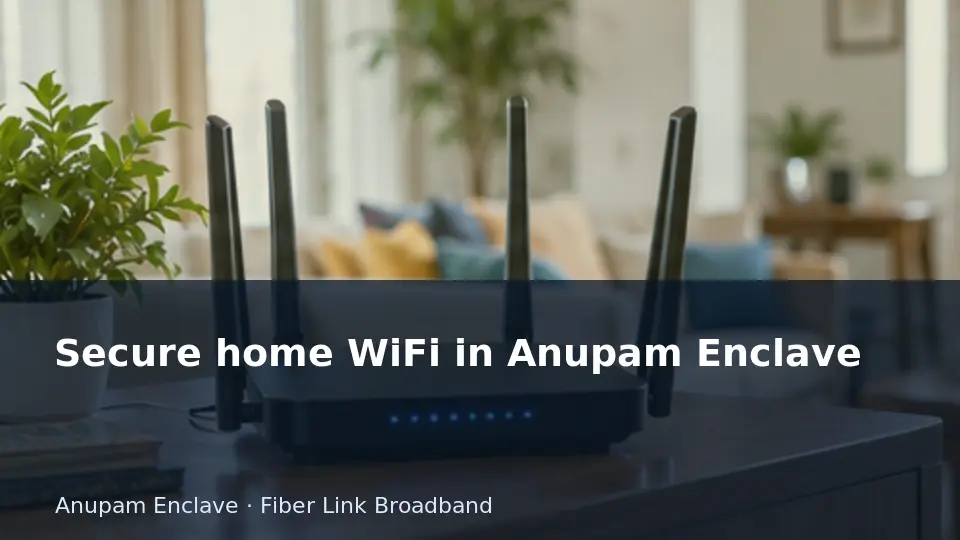
The password used to join WiFi and the password used to manage the router are different credentials. Changing only the network password can leave administration exposed.
This guide is for readers planning or reviewing a connection in Anupam Enclave. It separates the decision you can make now from details that need an address-specific reply. The examples describe checks you can perform or discuss with the installer; they are not reports of a customer installation, measured local speeds or a promise that every nearby building is serviceable.
Treat the indoor network as a separate system
The fiber connection normally reaches an optical terminal, while a router and its wireless radios serve the local devices. Some installations combine functions in one box, and others use separate equipment. The distinction matters because a working outside connection can coexist with poor wireless coverage. Before buying a faster package, establish whether a suitably connected wired device works as expected.
A coverage survey should reflect normal use. Test with doors and furniture in their ordinary positions, use the same device between rooms and note which band or access point serves it. A signal indicator is helpful but does not replace a real call or playback test. If additional equipment is needed, its link back to the main network is part of the design. A secondary unit with an unreliable backhaul can move the bottleneck without resolving it. Discuss permitted cable routes and access-point placement before selecting hardware.
Define the work that must remain usable
An office connection should be evaluated through the tools people actually use. Meetings, remote desktops, cloud documents and large transfers react differently to delay and congestion. A successful download-speed test does not prove that every work application is performing correctly, especially when a company VPN or remote server sits in the path. Include the responsible IT team when a managed application behaves differently from ordinary internet use.
Make the acceptance test concrete: identify the workstations, the normal meeting locations and the tasks that overlap at the busiest time. Use a wired baseline to separate the service from wireless coverage, then repeat the relevant workload from each essential room. Document what is included in the provider's service and what belongs to internal IT. For important work, also rehearse the permitted backup arrangement. Confirm its reception, account limits and application compatibility before it is needed; an untested backup is only a possibility, not an established continuity plan.
Separate visiting phones from smart-home controls
Guests need internet access without necessarily reaching lights, cameras or household computers. A guest network can reduce accidental access when the router implements isolation correctly.
Build a room-to-room WiFi acceptance sheet
Installation is easier to assess when everyone agrees which rooms need service. A vague request for full coverage leaves the important locations undefined.
Plan Ethernet between floors before choosing mesh
A wireless mesh node needs a usable connection back to the main router. Placing it upstairs inside an existing dead zone can repeat a weak signal instead of solving the problem.
Agree shared-home rules for large transfers
A shared home can experience avoidable congestion when every resident starts backups at the same time. Clear scheduling can be more effective than repeatedly restarting the router.
Choose between 2.4 GHz and 5 GHz using a room test
A device may work faster near the router on 5 GHz but stay connected farther away on 2.4 GHz. The result depends on the device, obstacles and interference.
Prepare smart-home devices for a router replacement
Changing the network name or password may require every sensor and plug to be enrolled again. A replacement can also change the supported security modes.
Agree the installation scope before reserving a slot
Booking a visit and agreeing the work are separate steps. Router position, cable route and any additional equipment should be discussed while changes remain easy.
Put the work desk on the network plan before installation
The best router position for a hall may be unsuitable for a distant office room. Specify the desk location while the cable route can still be planned.
Include Ethernet needs in the home installation request
A desktop, console or television may benefit from a wired connection. It is easier to discuss the cable route before installation than after the router is fixed.
Place office access points around desks and meeting areas
A router near the entrance may be convenient for installation but poor for the rooms where staff work. Plan the network around occupied desks and enclosed meeting spaces.
Prepare the rooms for a home WiFi installation
Clearing access to the agreed cable route helps the installer work without repeatedly moving furniture. It also makes the final route easier to inspect.
Keep the booking receipt and account details together
Payment evidence and service details are easiest to manage when stored as one installation record. They help resolve questions about the agreed package later.
Plan the home router location around daily use
A router installed beside the closest socket may leave the work desk or television poorly served. Mark the important rooms before deciding its position.
Check equipment compatibility before requesting gigabit
A gigabit request requires more than a plan label. The terminal, router ports, cable and test device can each impose a lower limit.
Plan wired ports for a compact office
Desktops, printers and meeting-room equipment may be easier to support on Ethernet. Count ports and cable routes before placing the main router.
Identify the correct Block A entrance for installation
A block label can still leave uncertainty about a building or entry point. A precise brief reduces the risk of checking the wrong premises.
Reserve room for growth in a small-workspace network
A workspace may add a printer, shared storage or another desk after installation. A little planning can avoid replacing every network component later.
Use the guide for your address
For Anupam Enclave, send Fiber Link Broadband the complete building address, floor and map pin when requesting feasibility or a current quotation. Mention the particular requirement covered by this article so the reply can address your use case. Ask for the service scope, equipment responsibilities and complete payable amount in writing. Retain the response alongside your installation or support record, and revisit any unanswered point before committing to a longer payment period.
Contact 9971524677 or 9990881098. Review the published plan information and request an address check. Current availability and terms need confirmation.
All Fiber Link broadband plans
Compare the monthly plans listed on our broadband plans page.
| Plan | Speed | Monthly price | Included benefits | Availability |
|---|---|---|---|---|
| Fiber Start | 100 Mbps | ₹499/month | Unlimited data, free installation, 24×7 customer support | Enquire |
| Fiber Plus | 200 Mbps | ₹699/month | Unlimited data, free installation, 24×7 priority support | Enquire |
| Fiber Pro | 300 Mbps | ₹799/month | Unlimited data, free installation, 24×7 priority support | Enquire |
| Fiber Ultra | 500 Mbps | ₹1,699/month | Unlimited data, free installation, 24×7 priority support | Enquire |
Router and billing terms: 5G dual-band Wi-Fi router refundable security applies. Confirm the deposit, applicable taxes, billing period, complete first payment and installation feasibility for your address before booking. Terms apply.
Business leased line: Custom bandwidth, equal upload and download speeds, SLA-backed uptime, static IP options and priority local support. Call 9971524677 for a custom quote.