
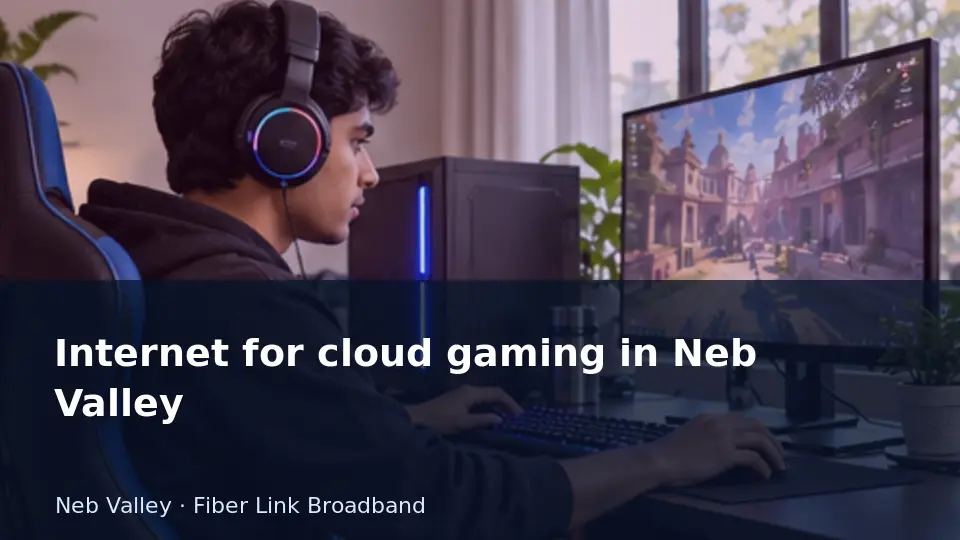
Cloud gaming combines incoming video with outgoing controller input. A line can download quickly while variable delay makes play feel inconsistent.
This guide is for readers planning or reviewing a connection in Neb Valley. It separates the decision you can make now from details that need an address-specific reply. The examples describe checks you can perform or discuss with the installer; they are not reports of a customer installation, measured local speeds or a promise that every nearby building is serviceable.
Separate throughput from responsiveness
Gaming uses several kinds of network activity. Downloading an update is a bulk transfer, a live match exchanges time-sensitive information, and cloud gaming carries a continuous interactive video stream. They should not be judged using the same single number. Latency to the selected game region, variation in delay and packet loss can matter more to live play than a high maximum download result.
A useful comparison changes one thing at a time. Keep the console or computer, game region and approximate time consistent, then compare Ethernet with WiFi. Repeat once with background downloads paused. If the problem follows household uploads, investigate contention. If it appears only with one game service, retain its diagnostic information and check the official service guidance. Avoid broad changes such as disabling the firewall or opening unnecessary ports. Any addressing or NAT question should be handled using the platform's supported instructions and the provider's confirmed network arrangement, without treating an upgrade as a universal cure.
Treat the indoor network as a separate system
The fiber connection normally reaches an optical terminal, while a router and its wireless radios serve the local devices. Some installations combine functions in one box, and others use separate equipment. The distinction matters because a working outside connection can coexist with poor wireless coverage. Before buying a faster package, establish whether a suitably connected wired device works as expected.
A coverage survey should reflect normal use. Test with doors and furniture in their ordinary positions, use the same device between rooms and note which band or access point serves it. A signal indicator is helpful but does not replace a real call or playback test. If additional equipment is needed, its link back to the main network is part of the design. A secondary unit with an unreliable backhaul can move the bottleneck without resolving it. Discuss permitted cable routes and access-point placement before selecting hardware.
Measure game latency to the server you actually use
Ping to a nearby speed-test server is not the same as latency to your game region. Routing and server location can affect the experience independently of download speed.
Check cloud-gaming service availability separately from broadband
Having fast broadband does not establish that a particular cloud-gaming platform supports your account, location or device. Those service requirements are independent.
Compare wired and wireless console play
Wireless interference can make latency vary even when the average speed appears healthy. A temporary Ethernet test is a useful diagnostic before purchasing equipment.
Build a useful gaming support report
A report saying only high ping leaves too many possible causes. The provider needs enough context to distinguish indoor WiFi from the external route.
Find out whether household uploads cause gaming lag
A background upload may coincide with a sudden increase in game delay. That pattern helps distinguish congestion at home from a remote server problem.
Investigate packet loss before chasing a lower ping number
Occasional missing packets can cause disruptive play even when typical ping looks reasonable. Focus on repeated loss and disconnects as well as delay.
Compare a 200 Mbps upgrade using the same test setup
Changing the test device or server at the same time as a plan makes the comparison unreliable. Keep the conditions consistent to understand what improved.
Measure useful speed without claiming the fastest provider
A local fastest-provider claim requires comparable evidence that a single household test cannot supply. Focus on whether the connection meets your own needs.
Check equipment compatibility before requesting gigabit
A gigabit request requires more than a plan label. The terminal, router ports, cable and test device can each impose a lower limit.
Choose between 2.4 GHz and 5 GHz using a room test
A device may work faster near the router on 5 GHz but stay connected farther away on 2.4 GHz. The result depends on the device, obstacles and interference.
Keep cloud backups from consuming the whole connection
A backup can run for hours while family members are online. Unlimited data helps with volume, but the backup still competes for upload capacity and can delay interactive traffic.
Can an unlimited line replace a mobile hotspot
A fixed connection can move routine streaming and computer updates away from a phone allowance. Keep the hotspot available for an outage, but first test its indoor reception and check whether tethering is included in your mobile terms.
Build a household data diary before renewal
A useful usage diary records activities, not private browsing history. Note when streaming, cloud backup and software updates overlap, then compare those busy periods with observed problems.
Follow up a support ticket with new evidence
Repeated messages saying still not working add less value than a changed symptom or a new controlled test. Keep updates in the existing ticket where possible.
Understand why a gigabit WiFi test may be lower
Wireless throughput depends on the client radio, channel conditions and distance. Even a gigabit subscription does not promise that every phone will display a gigabit result.
Test whether 300 Mbps reduces a busy-hour queue
A higher tier may help when several sustained transfers compete for a genuinely saturated connection. It does not automatically fix packet loss or a weak signal.
Survey a large home room by room
A single speed test beside the router cannot show coverage across a large home. Furniture, walls and device differences make a room-level survey more useful.
Use the guide for your address
For Neb Valley, send Fiber Link Broadband the complete building address, floor and map pin when requesting feasibility or a current quotation. Mention the particular requirement covered by this article so the reply can address your use case. Ask for the service scope, equipment responsibilities and complete payable amount in writing. Retain the response alongside your installation or support record, and revisit any unanswered point before committing to a longer payment period.
Contact 9971524677 or 9990881098. Review the published plan information and request an address check. Current availability and terms need confirmation.
All Fiber Link broadband plans
Compare the monthly plans listed on our broadband plans page.
| Plan | Speed | Monthly price | Included benefits | Availability |
|---|---|---|---|---|
| Fiber Start | 100 Mbps | ₹499/month | Unlimited data, free installation, 24×7 customer support | Enquire |
| Fiber Plus | 200 Mbps | ₹699/month | Unlimited data, free installation, 24×7 priority support | Enquire |
| Fiber Pro | 300 Mbps | ₹799/month | Unlimited data, free installation, 24×7 priority support | Enquire |
| Fiber Ultra | 500 Mbps | ₹1,699/month | Unlimited data, free installation, 24×7 priority support | Enquire |
Router and billing terms: 5G dual-band Wi-Fi router refundable security applies. Confirm the deposit, applicable taxes, billing period, complete first payment and installation feasibility for your address before booking. Terms apply.
Business leased line: Custom bandwidth, equal upload and download speeds, SLA-backed uptime, static IP options and priority local support. Call 9971524677 for a custom quote.